

Print it, save it, or add it to your recipe binder.
Garlic butter chicken scalloped potatoes combine thin potato slices, cooked chicken, and a warm garlic cream sauce beneath a golden cheddar topping. The butter carries the garlic through the layers, while the cream and milk keep the casserole rich and spoonable.
It is a hearty oven dinner that works with shredded roast chicken, rotisserie chicken, or other safely stored cooked chicken. Start with evenly sliced potatoes, keep the dish tightly covered for the first bake, and uncover only when the potatoes are nearly tender.
Why This Chicken and Potato Bake Works
- Even potato slices: Thin, consistent pieces soften more reliably than a mix of thick and thin cuts.
- Garlic butter sauce: Briefly warming the garlic in butter distributes its flavor without browning it.
- Covered cooking first: Foil traps moisture while the potatoes soften.
- Cheese at the end: The cheddar has time to melt and color without spending the full bake on top.
This is a creamy layered casserole, not a crisp potato gratin with a dry interior. The sauce settles a little as the dish rests, but warm portions will still be soft and rich.
Ingredients and Helpful Choices
- 2 pounds potatoes, about 4 large or 5 to 6 medium
- 2 cups cooked chicken, shredded or diced
- 1 cup heavy cream
- 1 cup whole milk
- 1 cup shredded cheddar cheese
- 4 tablespoons unsalted butter
- 4 garlic cloves, minced
- Up to 1 teaspoon salt, to taste
- 1/2 teaspoon black pepper
- 1 teaspoon dried thyme, optional
- Extra butter or cooking spray, for the dish
Potatoes: Use the weight as your guide because a medium potato can vary considerably in size. Yukon Gold potatoes hold their shape with a creamy texture, while russets give a softer, starchier result. Either works when sliced evenly.
Cooked chicken: Shred or dice it into bite-size pieces. If using rotisserie chicken, remove the bones and skin as desired. Taste its seasoning before deciding how much salt the sauce needs. Raw chicken is not a direct substitute in this method.
Cream and milk: Heavy cream gives richness, and whole milk helps the sauce reach between the potato slices. This version does not use a flour roux; the sauce remains creamy, with some body from the potato starch.
Butter and garlic: Use unsalted butter so you can control seasoning. Stir the garlic over gentle heat and add the dairy before it becomes brown or bitter.
Cheddar and thyme: Sharp cheddar gives a pronounced cheese finish. Dried thyme is optional; use it if you want an herbal note with the garlic and chicken.
How to Make Garlic Butter Chicken Scalloped Potatoes
1. Prepare the oven and potatoes
Heat the oven to 375 degrees F and grease a 9×13-inch baking dish. Peel the potatoes if desired, then slice evenly about 1/8 inch thick. A mandoline with its hand guard is useful. Keep the slices similar in thickness so they finish together. Use already cooked chicken, not raw chicken.
2. Warm the garlic cream sauce
Melt the 4 tablespoons butter in a saucepan over medium-low heat. Add the minced garlic and stir for about 30 to 60 seconds until fragrant, without browning. Stir in the cream, milk, pepper, optional thyme, and salt to taste. Warm gently until steaming, then remove from the heat; do not boil vigorously. Use less salt if the chicken is already well seasoned.
3. Build the layers
Arrange one-third of the potato slices in the dish, overlapping slightly. Add half the cooked chicken and pour over one-third of the warm sauce. Repeat with another third of the potatoes, the remaining chicken, and another third of the sauce. Finish with the remaining potatoes and sauce, distributing the garlic through the layers. Reserve the cheddar for later.
4. Bake covered until nearly tender
Cover the dish tightly with foil and bake for 45 to 60 minutes. Carefully lift the foil away from your face and test the center potatoes with a thin knife. They should be nearly tender before you uncover the dish for browning. If still firm, reseal and continue baking in 10-minute intervals.
5. Add cheese and finish
Remove the foil, scatter the cheddar evenly over the top, and bake uncovered for about 15 to 20 minutes. The potatoes must be fully tender and the center of the casserole must reach 165 degrees F. Total baking is usually 60 to 80 minutes, but thicker slices or cold ingredients can take longer. Tent loosely if the surface browns too quickly.
6. Rest and serve
Rest for about 10 minutes before serving so the sauce can settle around the layers. Serve with a broad spatula or spoon; the hot casserole will be creamy rather than perfectly firm.
Getting the Potatoes Tender Without Overbrowning
Thickness is the most useful thing to control. Aim for slices about 1/8 inch thick and avoid leaving a few much thicker pieces in the center. If using a mandoline, keep its hand guard in place and stop before the final small potato piece becomes difficult to hold safely.
Seal the foil around the edges of the dish. A loose cover lets moisture escape before the potatoes soften. At the first check, test a central layer rather than only a slice at the edge, where the casserole cooks more quickly.
If the potatoes are firm, keep baking covered. Adding the cheese and trying to brown the top early will not make the middle cook faster. Once the slices are nearly tender, remove the foil and finish the topping.
Use two separate checks at the end: a knife should slide through the potatoes easily, and a thermometer should read 165 degrees F in the center. Potato tenderness and safe reheating are related to cooking time, but one does not replace the other.
Timing and Sauce Texture
Allow about 20 minutes for preparation, up to 1 hour and 20 minutes for baking, and 10 minutes of resting. The total estimate assumes the chicken is already cooked. An especially cold filling, thicker slices, or a deeper dish can take longer.
The sauce may look quite fluid while the casserole is bubbling hot. A short rest lets it settle around the potatoes. Do not expect the same firm slices as a chilled casserole, and do not keep baking a fully tender dish solely to eliminate every bit of liquid.
Gentle heating helps keep the dairy sauce smooth. Avoid boiling it hard in the saucepan. Some separation can still happen with a rich baked sauce, especially after freezing and reheating; that does not by itself indicate whether food has been stored safely.
Serving Ideas and Variations
The chicken and potatoes make a substantial main dish. Serve with a green salad, steamed green beans, or roasted broccoli to add a lighter vegetable alongside the creamy layers.
For a different cheese finish, replace part of the cheddar with Gruyere or Monterey Jack. Keep the overall amount similar so the topping does not overwhelm the potatoes. If adding cooked vegetables, drain them thoroughly and use a modest amount to avoid changing the moisture balance.
For another layered chicken dinner, try golden chicken and spinach potato gratin. The chicken broccoli cheddar gnocchi bake offers a different creamy base.
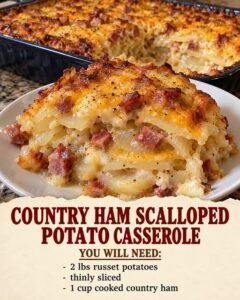
For a ham variation on scalloped potatoes, see country ham scalloped potato casserole. Or pair a simpler potato side with brown sugar roast chicken with carrots for another oven-centered meal.
Make-Ahead, Storage, and Reheating
For an easy head start, shred the cooked chicken, grate the cheese, and measure the seasonings ahead, keeping perishables refrigerated. Slice the potatoes close to assembly for the simplest workflow. A fully assembled cold casserole generally needs longer to heat through than the warm-sauce method described here.
Refrigerate leftovers within 2 hours, or within 1 hour above 90 degrees F. Divide into shallow containers and keep at 40 degrees F or below. Use within 3 days, sooner if the cooked chicken was already near the end of its storage window. Baking older chicken into a casserole does not reset its safe storage time.
Reheat portions until the center reaches 165 degrees F, following the USDA leftovers guidance. Cover loosely for oven reheating, or microwave in short intervals and check several spots. A small splash of milk can loosen sauce that has thickened, but avoid flooding the dish.
Freeze cooled individual portions airtight for up to 2 months for quality, then thaw in the refrigerator. The potatoes may soften further and the dairy sauce may separate a little after reheating.
Frequently Asked Questions
Can I use raw chicken?
Do the potatoes need to be peeled?
Why are my potatoes still firm?
Why add the cheddar later?
Can I use rotisserie chicken?
Will the casserole cut into firm squares?
A Creamy Garlic Butter Dinner
Serve the rested casserole while the cheddar is warm and the potatoes are fully tender. Even slices, a tightly covered first bake, and a final center-temperature check are the main steps that keep this layered dinner straightforward.

Garlic Butter Chicken Scalloped Potatoes
Thinly sliced potatoes and cooked chicken baked in garlic butter cream sauce with a golden cheddar topping.
Prep: 20 min | Cook: 80 min | Total: 110 min
Servings: 6 servings
Ingredients
- 2 pounds potatoes, about 4 large or 5 to 6 medium
- 2 cups cooked chicken, shredded or diced
- 1 cup heavy cream
- 1 cup whole milk
- 1 cup shredded cheddar cheese
- 4 tablespoons unsalted butter
- 4 garlic cloves, minced
- Up to 1 teaspoon salt, to taste
- 1/2 teaspoon black pepper
- 1 teaspoon dried thyme, optional
- Extra butter or cooking spray, for the dish
Instructions
- Heat oven to 375 degrees F. Grease a 9x13-inch dish. Slice potatoes evenly 1/8 inch thick.
- Melt butter; stir in garlic 30 to 60 seconds without browning. Add cream, milk, seasonings, and optional thyme. Warm gently; do not boil hard.
- Layer one-third potatoes, half chicken, and one-third sauce. Repeat. Finish with remaining potatoes and sauce. Reserve cheese.
- Cover tightly with foil. Bake 45 to 60 minutes, until center potatoes are nearly tender; extend covered baking if still firm.
- Uncover; add cheddar. Bake 15 to 20 minutes, until potatoes are tender and center reaches 165 degrees F. Rest 10 minutes.
Nutrition
- Calories:
- Fat:
- Carbs:
- Protein:
Rate This Recipe
Average Rating: 0 (0 votes)